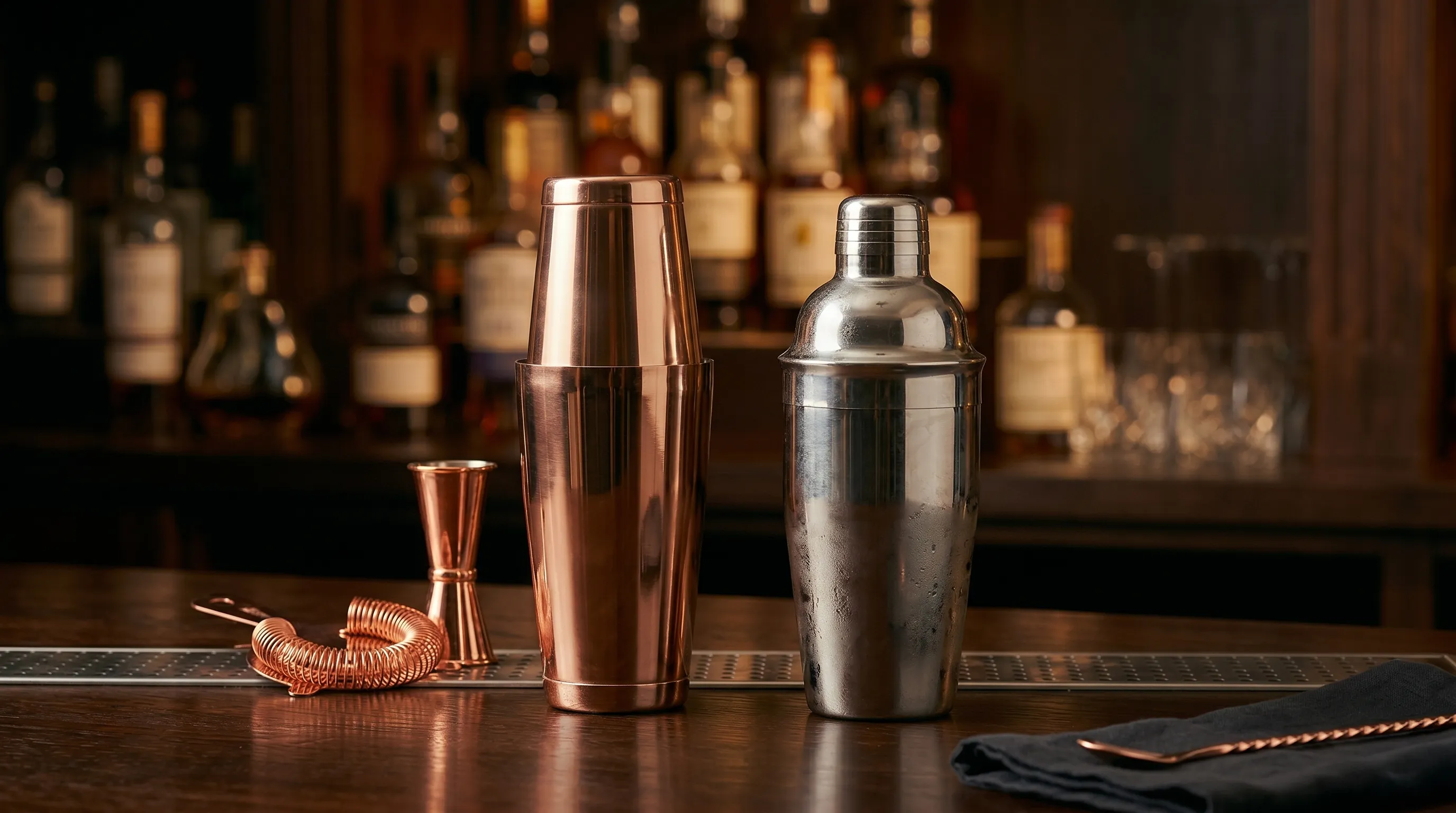
At a glance: A cobbler shaker is easier for your first cocktail. A Boston shaker is better for almost every cocktail after that. Cobbler shakers are self-contained and beginner-friendly, but they can stick, leak, and strain slowly. A tin-on-tin Boston shaker has a small learning curve, but it is faster, easier to clean, more durable, and the shaker I would recommend for anyone building a real home bar.
Choosing a cocktail shaker seems like it should be simple. You need something to shake drinks in, so you buy the thing called a cocktail shaker.
Then you look online and find three-piece shakers, two-piece shakers, glass-and-tin shakers, weighted tins, unweighted tins, built-in strainers, Hawthorne strainers, Parisian shakers, gift sets, copper finishes, matte black finishes, and a dozen tools bundled into kits you probably do not need.
This is where a lot of home bars go wrong. Not because the shaker is complicated, but because most cocktail equipment is sold as a lifestyle object before it is sold as a tool.
A cocktail shaker has one job: chill, dilute, and aerate a drink quickly. That is it. The right shaker makes that easier. The wrong one makes it annoying enough that you stop using it.
Why the Shaker Matters
A shaker is not just a cold metal container. It changes the texture of a drink.
You shake cocktails when the ingredients need more force than stirring can provide. Citrus, juice, cream, egg white, aquafaba, syrups, and fruit all need agitation. Shaking chills the drink, adds controlled dilution, incorporates air, and gives the finished cocktail the brightness and texture you expect from a Margarita, Daiquiri, Whiskey Sour, or Clover Club.
Stirred drinks are about silk and clarity. Shaken drinks are about energy.
That is why the shaker matters. Not because it looks good on the bar, but because it affects how confidently you can shake, how quickly you can strain, and how much frustration sits between you and the drink.
If the shaker leaks, sticks shut, feels too small, or takes forever to pour through a tiny built-in strainer, you will notice. Maybe not on the first drink. Definitely by the third.
What Is a Cobbler Shaker?
A cobbler shaker is the classic three-piece cocktail shaker most people picture first. It has a main tin, a fitted top with a built-in strainer, and a small cap.
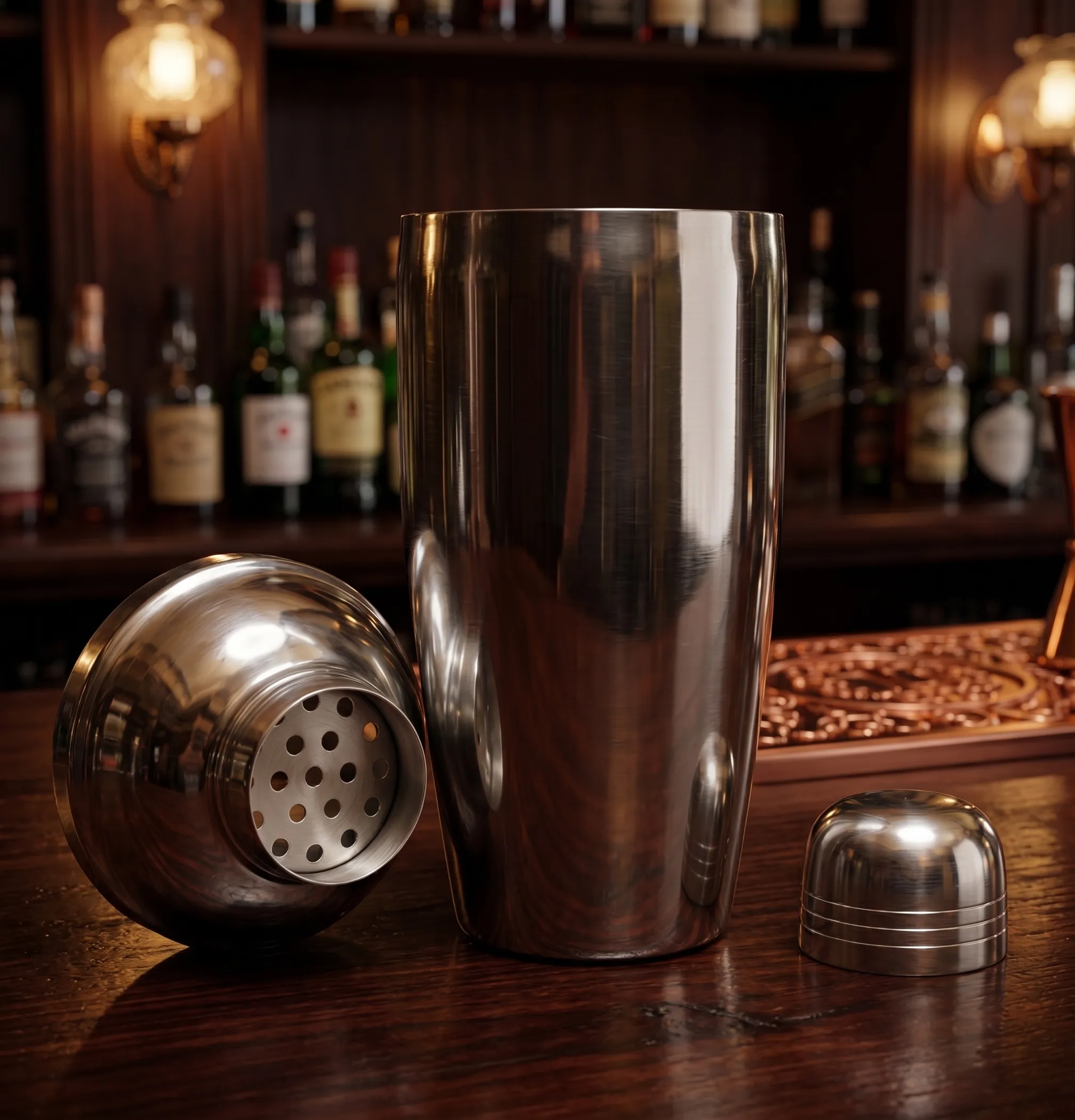
The appeal is obvious. Everything is included. You add ingredients, add ice, put on the top, shake, remove the cap, and pour through the built-in strainer. No separate Hawthorne strainer. No technique for sealing two tins together. No learning curve.
For a beginner, that can feel reassuring.
And to be clear: a good cobbler shaker can make a good cocktail. There is nothing inherently wrong with the format. The problem is not the idea. The problem is how cobbler shakers behave in real use, especially the cheap ones that come in most cocktail kits.
They often have three issues.
They Stick
As the metal chills, the pieces contract. The top can lock onto the tin, and the small cap can lock onto the strainer section. This is especially common with thin, inexpensive cobbler shakers. You finish shaking, then spend the next minute fighting the tool instead of pouring the drink.
They Strain Slowly
The built-in strainer holes are small. That sounds convenient until you are trying to pour a drink with citrus pulp, crushed ice, or egg-white foam. The flow can be slow and uneven, and the final pour often feels less controlled than using a separate strainer.
They Are Usually Smaller
Many cobbler shakers do not leave much room once you add liquid and ice. A cramped shaker does not aerate as well, and it is less forgiving if you are making larger drinks or anything with egg white.
None of this means you cannot use one. It means the cobbler shaker is best understood as convenient, not necessarily better.
What Is a Boston Shaker?
A Boston shaker is a two-piece shaker. Traditionally, it used one metal tin and one mixing glass. Today, the better home and professional setup is usually tin-on-tin: one large metal tin and one smaller metal tin that fit together.
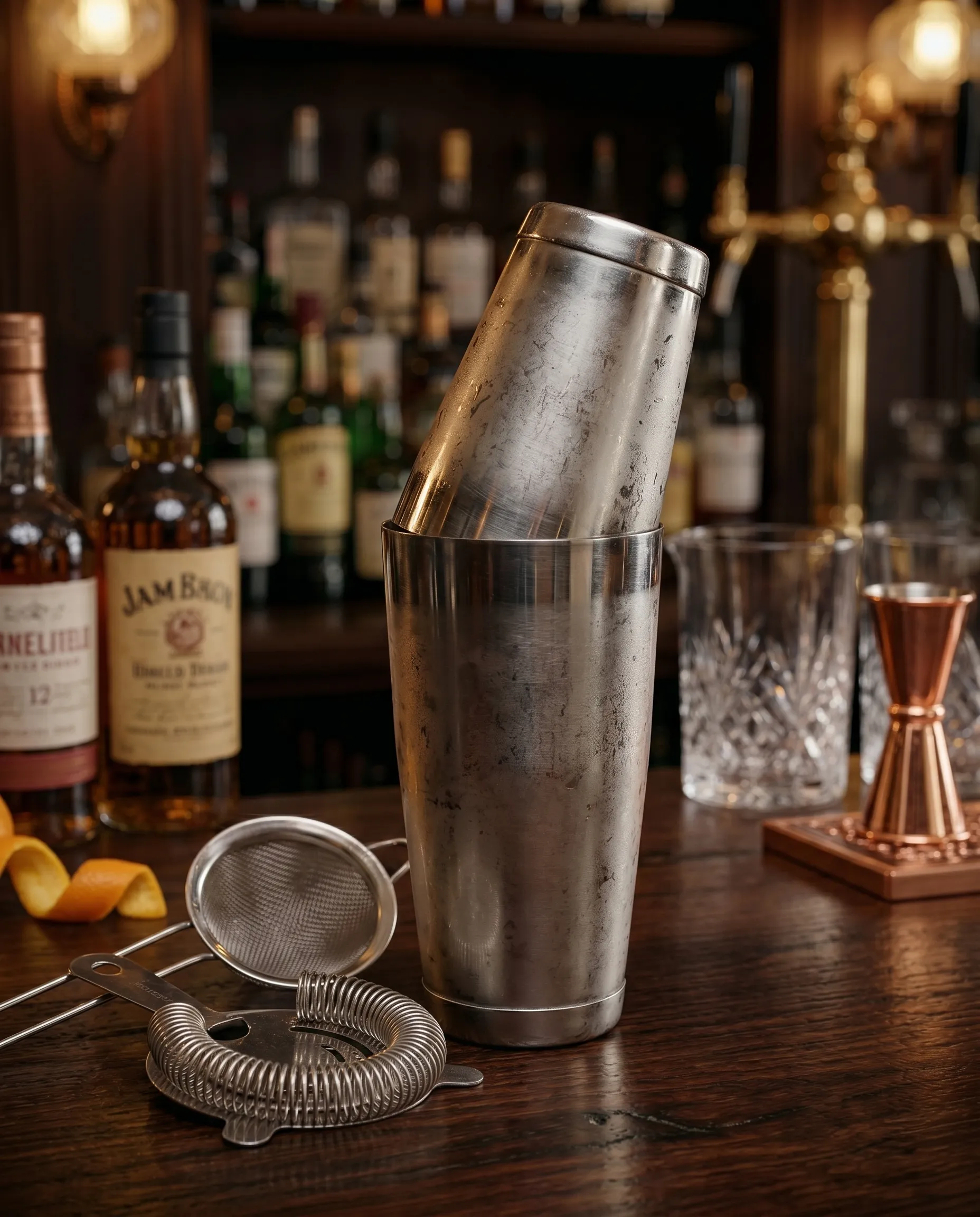
A Boston shaker does not have a built-in strainer. After shaking, you open the tins and strain the drink with a Hawthorne strainer.
This sounds less convenient until you use one for a week. Then it starts to make sense.
A Boston shaker is faster to fill, faster to seal, faster to open, and easier to clean. It gives the drink more space to move, which improves aeration. It is also far less fussy once you learn the basic seal and release.
The learning curve is real, but small.
You add your ingredients and ice to the larger tin, place the smaller tin at a slight angle into the opening, and give it a firm tap to seal. Shake hard. To open it, tap the side of the larger tin where the seal is weakest. The tins release.
That is the whole skill. A little awkward the first few times, then completely normal.
The Strainer Question
This is the one catch with a Boston shaker: it does not have a built-in strainer.
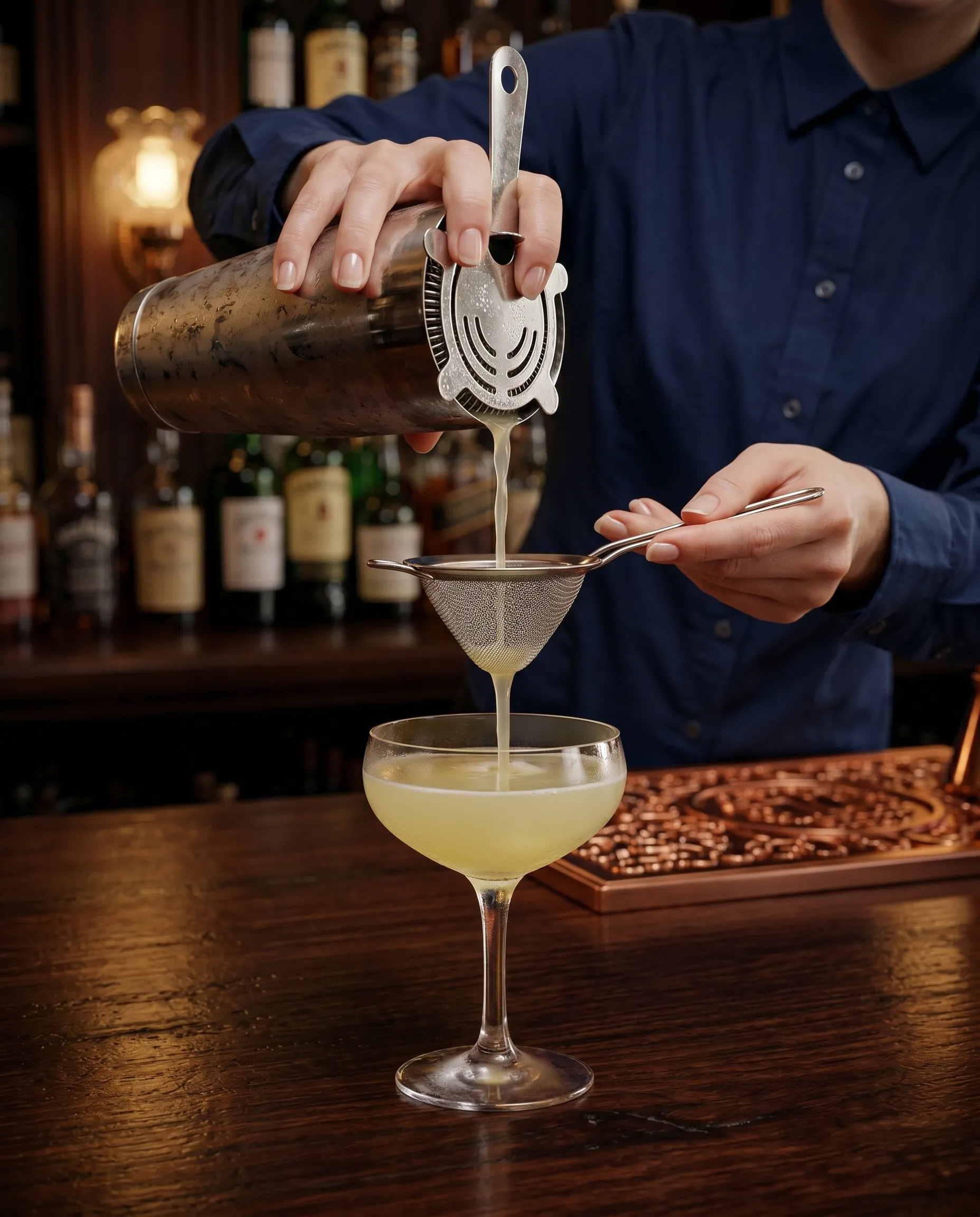
That sounds like a downside until you use a proper Hawthorne strainer. A Hawthorne strainer is the flat metal strainer with a spring around the edge. It sits over the mouth of the shaker tin and holds back the ice as you pour. Compared with the tiny built-in strainer on most cobbler shakers, it is faster, cleaner, and gives you much better control.
The spring matters. It flexes against the inside of the tin, helping catch ice shards, citrus pulp, and small pieces of fruit or herbs. You can also adjust how tightly you pour by pressing the strainer down with your finger. That small bit of control is one of the reasons a Boston shaker feels better once you get used to it.
A fine mesh strainer is the next step, but it is optional. You use it when you want to double strain: first through the Hawthorne strainer, then through the fine mesh strainer into the glass. This catches the tiny pieces the Hawthorne strainer lets through.
Double straining is useful for drinks with fresh citrus, egg white, aquafaba, muddled fruit, mint, or anything shaken hard enough to create small ice chips. It gives the finished drink a cleaner texture and a more polished surface.
For most home bartenders, the setup is simple:
Hawthorne Strainer
Essential if you use a Boston shaker. It holds back the ice, controls the pour, and is much faster than the built-in strainer on most cobbler shakers.
Fine Mesh Strainer
Optional but useful. Use it for double straining when you want to remove citrus pulp, egg-white strands, tiny ice shards, herbs, or fruit pieces from a shaken drink.
You do not need to worry about a julep strainer yet. That belongs with stirred drinks and mixing glasses, not with the shaker decision.
Which One Is Easier?
For the first drink, the cobbler shaker is easier.
For the tenth drink, the Boston shaker is easier.
That distinction matters. A cobbler shaker wins on immediate understanding. You can hand one to someone who has never made a cocktail and they will understand the basic idea in seconds. Lid on. Cap on. Shake. Cap off. Pour.
The Boston shaker asks you to learn two small things: how to seal it and how to open it. But once those become muscle memory, it becomes the easier tool because there is less to fight. No stuck cap. No slow built-in strainer. No tiny top piece rolling under the counter. No decorative parts pretending to be useful.
Boston shaker: easier to live with
Which One Makes Better Drinks?
A Boston shaker does not magically make better cocktails. You can make an excellent Daiquiri in a cobbler shaker and a terrible one in a Boston shaker.
The drink still depends on the fundamentals: fresh citrus, accurate measurement, enough ice, a hard shake, and proper dilution.
But the Boston shaker gives you better working conditions.
It has more internal space, so the ice and liquid move more freely. That helps with aeration, which is especially important for citrus drinks and sours. It also gives you more confidence to shake hard because the tool feels solid and secure once sealed.
That confidence matters. A timid shake gives you a worse drink.
With a Boston shaker, the pour is also cleaner because you are using a Hawthorne strainer. You can control the flow, hold back ice more effectively, and double strain through a fine mesh strainer when you want a smoother texture.
The difference is not magic. It is workflow. Better workflow leads to better repeatability, and repeatability is what a home bar needs.
Why Boston Shakers Are Better Long Term
The Boston shaker is the better long-term buy for four reasons.
Two tins are quicker to use than three cobbler pieces. Fill, seal, shake, pop open, strain. Once you know the motion, there is very little friction.
No tiny cap, no built-in strainer holes, no awkward crevices. Rinse the tins and move on. This matters more than people think, especially when making several drinks.
More room means better shaking. The ice can move, the drink aerates, and egg-white or aquafaba cocktails have the space they need to build texture.
A good tin-on-tin Boston shaker is hard to kill. There are no caps to lose, no built-in strainers to clog, and no decorative mechanisms to fail. It is a tool, not a novelty.
This is why professional bartenders use Boston shakers. Not because they are trying to make things difficult. Because they are efficient.
What About Dry Shaking?
This is where the Boston shaker really pulls ahead.
A dry shake is the technique used for cocktails with egg white or aquafaba. You shake the ingredients without ice first to build foam, then add ice and shake again to chill and dilute. Drinks like the Whiskey Sour, Clover Club, and Pisco Sour depend on this technique.
A Boston shaker is better for this because it gives the ingredients more space and handles pressure changes more comfortably. Egg-white drinks expand as they foam. A small cobbler shaker can feel cramped, and the cap can become annoying once pressure and foam are involved.
If you make egg-white cocktails even occasionally, the Boston shaker is the easier recommendation. It gives you room to shake hard, room for foam to build, and a cleaner path to double straining.
If you want the full technique, read the guide to the dry shake. The short version is this: the first shake builds foam, the second shake chills the drink. A Boston shaker handles both better.
When a Cobbler Shaker Still Makes Sense
There are still reasons to buy a cobbler shaker.
If you make cocktails only occasionally, want something self-contained, and value simplicity over speed, a cobbler shaker is fine. It can also make sense as a gift because it looks familiar and does not require buying a separate strainer.
A high-quality cobbler shaker is also much better than the cheap versions included in most cocktail kits. If you love the look and enjoy using it, there is no rule that says you have to switch.
The main thing is to avoid the flimsy version: thin metal, poor fit, decorative finish, tiny capacity, and a cap that feels like it will weld itself shut the moment it gets cold.
A cobbler shaker should feel solid. The pieces should fit cleanly. The cap should come off without a wrestling match. If it feels like a prop, skip it.
What I Would Buy
For most home bartenders, I would buy a weighted tin-on-tin Boston shaker and a Hawthorne strainer. Pair it with the first 10 bottles for a serious home bar and you are most of the way to a working setup.
That is the setup.
Weighted Tin-on-Tin Boston Shaker
Look for a large tin and a smaller tin, both stainless steel, with a little weight at the base. Tin-on-tin is more durable than glass-and-tin, chills quickly, and is less likely to break if you are moving quickly or washing up late at night.
Hawthorne Strainer
This is the spring-edged strainer that sits over the shaker tin and holds back ice. It gives you a cleaner, faster pour than most built-in cobbler strainers and is essential if you use a Boston shaker.
Fine Mesh Strainer
Not mandatory, but useful. If you make citrus drinks, egg-white drinks, or anything with muddled fruit, a fine strainer catches small ice shards and pulp. It is one of the few upgrades that earns its place quickly.
Brands like Cocktail Kingdom and A Bar Above make reliable versions of these tools. You do not need anything ornate. Stainless steel, good fit, comfortable feel. That is enough.
Avoid giant cocktail kits unless you know every piece in the kit is something you actually want. Most kits include filler: weak muddlers, awkward spoons, decorative pourers, tiny tongs, and a shaker that is not as good as the one you would have bought separately.
The Best Shaker for Different Drinks
Different drinks reveal the shaker decision in different ways.
Citrus, syrup or liqueur, and plenty of ice. A hard shake gives the drink brightness and texture. The Boston shaker makes the process fast and clean.
A Daiquiri is simple enough to expose every mistake. Proper measurement matters, but so does shaking hard enough to chill and dilute without turning the drink watery.
If you use egg white, the Boston shaker is the better tool. More room for foam, better agitation, easier double straining.
If you only shake the occasional drink and want the simplest possible setup, a good cobbler shaker can do the job. Just buy a decent one.
The Mistakes to Avoid
The biggest mistake is buying for appearance instead of use.
A shaker is going to get cold, wet, sticky, dented, rinsed, dropped, and used with force. It should be comfortable in your hands and easy to clean. That matters more than the finish.
Avoid shakers that are too small. Avoid novelty shapes. Avoid anything with a complicated mechanism. Avoid cheap cobbler shakers with loose-fitting tops. Avoid glass Boston shaker halves unless you specifically want the look and accept the risk.
The best shaker is slightly boring. That is usually a good sign.
The cobbler shaker is not wrong. It is approachable, self-contained, and perfectly capable in the right hands. But if you are building a home bar you will actually use, the Boston shaker is the better buy.
It asks you to learn one small technique, then pays you back every time you make a drink.
Faster to use. Easier to clean. Better for shaking hard. Better for dry shaking. Better for making more than one drink. Better long term.
Start with a tin-on-tin Boston shaker, a Hawthorne strainer, and a jigger. That setup will take you much further than a decorative cocktail kit ever will. If you want the wider list, the four bar tools you actually need covers the rest.
If you already have the bottles on your shelf, Alchemy will show you what you can make with them. The shaker is how you make those drinks properly.
Common Questions
A cobbler shaker is the easiest cocktail shaker to understand at first because it has a built-in strainer and cap. But for most people who plan to make cocktails regularly, a tin-on-tin Boston shaker is the better long-term choice. It is faster, easier to clean, less likely to jam, and gives you more room to shake properly.
A cobbler shaker is a three-piece shaker with a metal tin, a built-in strainer top, and a small cap. A Boston shaker is a two-piece shaker, usually made from two metal tins or one tin and one mixing glass. Boston shakers require a separate Hawthorne strainer, but they are quicker, more durable, and widely used by professional bartenders.
Yes. A Boston shaker does not have a built-in strainer, so you need a Hawthorne strainer to hold back the ice when pouring the drink. This is not a downside. A separate strainer gives you better control and is usually faster than the small built-in strainer on a cobbler shaker.
A fine mesh strainer is optional, but useful if you make drinks with citrus pulp, egg white, aquafaba, muddled fruit, herbs, or small ice shards. It is used for double straining: first through a Hawthorne strainer, then through the fine mesh strainer into the glass for a cleaner texture.
No. Cobbler shakers are not bad, and a good one can make excellent cocktails. The problem is that cheap cobbler shakers often leak, stick shut, strain slowly, and become frustrating once you make more than one or two drinks. They are convenient at first, but less practical over time.