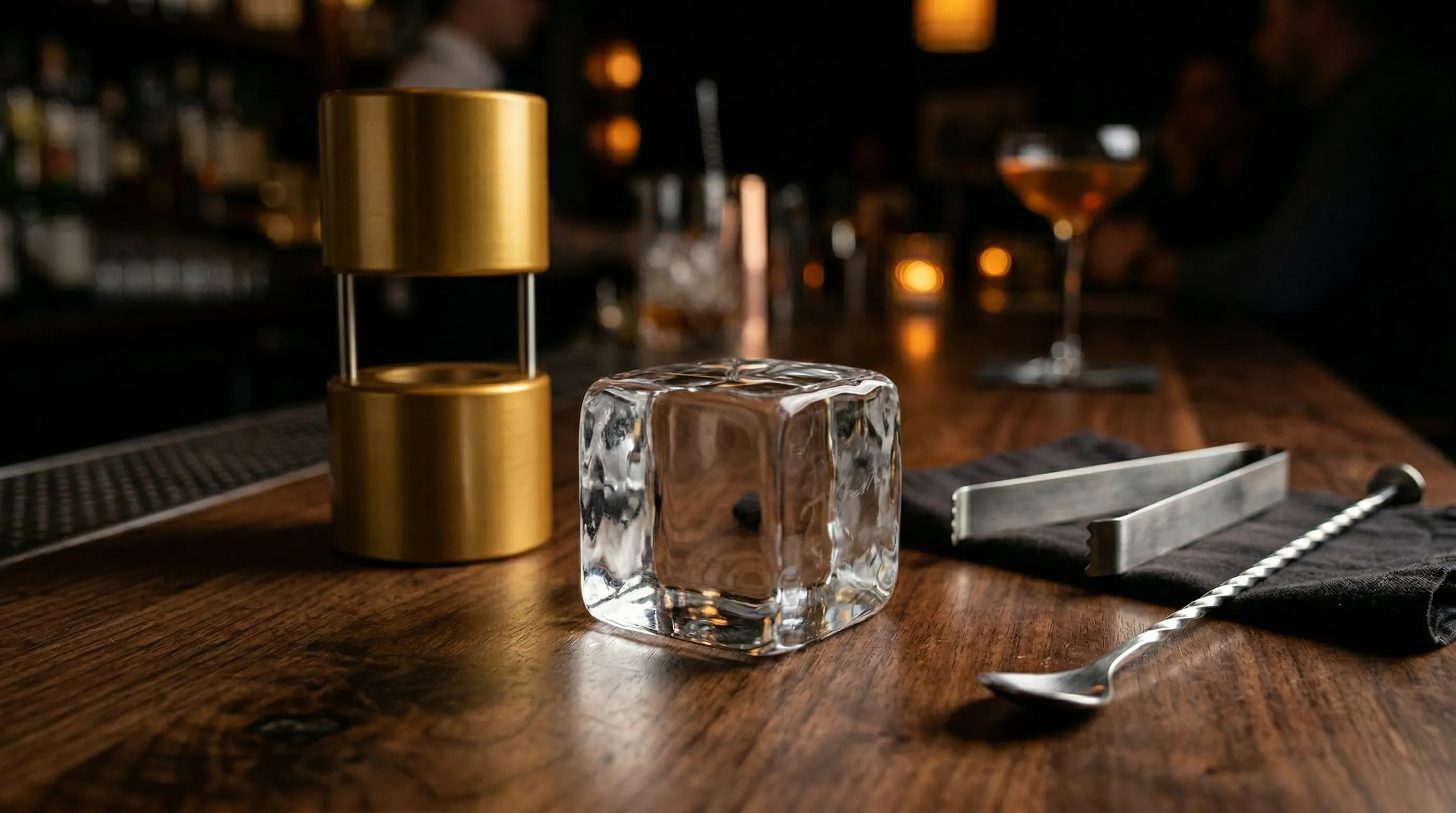
At a glance: Home ice is cloudy because freezers freeze water from all sides, trapping air and minerals. The fix is directional freezing: place a small cooler of water in your freezer with the lid off, and 24 to 48 hours later the top 70 percent will be clear. Cut into 2-inch cubes and they melt roughly four times slower than standard ice. Worth it for spirit-forward drinks. For everything else, it is mostly vanity.
Most home bars get almost everything right before they get their ice right. You can stock the right bottles, buy the right tools, learn the techniques, and still pour a beautiful Old Fashioned over a cloudy, fractured cube that looks like it came out of a gas station bag. Bartenders at craft bars noticed this problem about fifteen years ago and solved it. Most home bartenders still have not.
Clear ice is the single biggest visual upgrade you can make to a stirred drink, and once you see one next to a cloudy cube, you cannot unsee it. The good news is that the method for making it at home is simple, cheap, and requires one piece of equipment you probably already own.
Why Home Ice Turns Cloudy
Water is rarely just water. Tap water contains dissolved gases - mostly oxygen and nitrogen - and trace minerals. When water freezes slowly, those dissolved elements have time to escape the ice lattice as it forms. When water freezes quickly and from all sides at once, they do not. They get trapped in the center, compressed into the last part of the cube to solidify, and the result is that distinctive white cloudy core.
Your freezer is designed to freeze fast and evenly. An ice cube tray sitting in a cold box gets cold air hitting it from above, below, and all sides at the same time. The outer layers freeze first, forming a solid shell around liquid water. As the center freezes, it has nowhere to push the dissolved air out to. The air stays put, and the ice goes cloudy.
That is the whole problem. Solve for one direction of freezing, and the cloudiness disappears.
The Science: Directional Freezing
Craft bars solve this with expensive Clinebell machines - commercial units used in high-end bar programs - that freeze a block of water from the top down over several days, pushing all the air and impurities to the bottom, which is then cut off and discarded. What remains is a gin-clear block you can carve into perfect spheres, cubes, and spears.
The Cooler Method
Here is the whole setup. It is almost absurdly simple.
A Small Insulated Cooler
Six to nine quarts is ideal. Too small and you will not get enough usable ice per cycle; too big and the block will not fit in most home freezers. A cheap hard-sided cooler from any hardware store works perfectly - this is not the place to spend money.
Filtered Water
Distilled water is not required. Filtered tap water is usually fine. What you are avoiding is water with heavy mineral content, which can leave a faint haze even with directional freezing. If your tap water tastes clean, it will freeze clean.
A Freezer With Vertical Clearance
The cooler needs to fit in your freezer with the lid off. Most upright freezers handle a 6-quart cooler without issue. If you have a small freezer or a French-door fridge with limited vertical space, measure first. This is the only step that sometimes defeats people.
A Serrated Knife and Mallet
For breaking the block into cubes or spears. A long bread knife and a small wooden mallet are all you need. Score the ice along the line you want, place the knife in the score, and tap firmly with the mallet. The ice cracks along the score with very little effort.
The Method
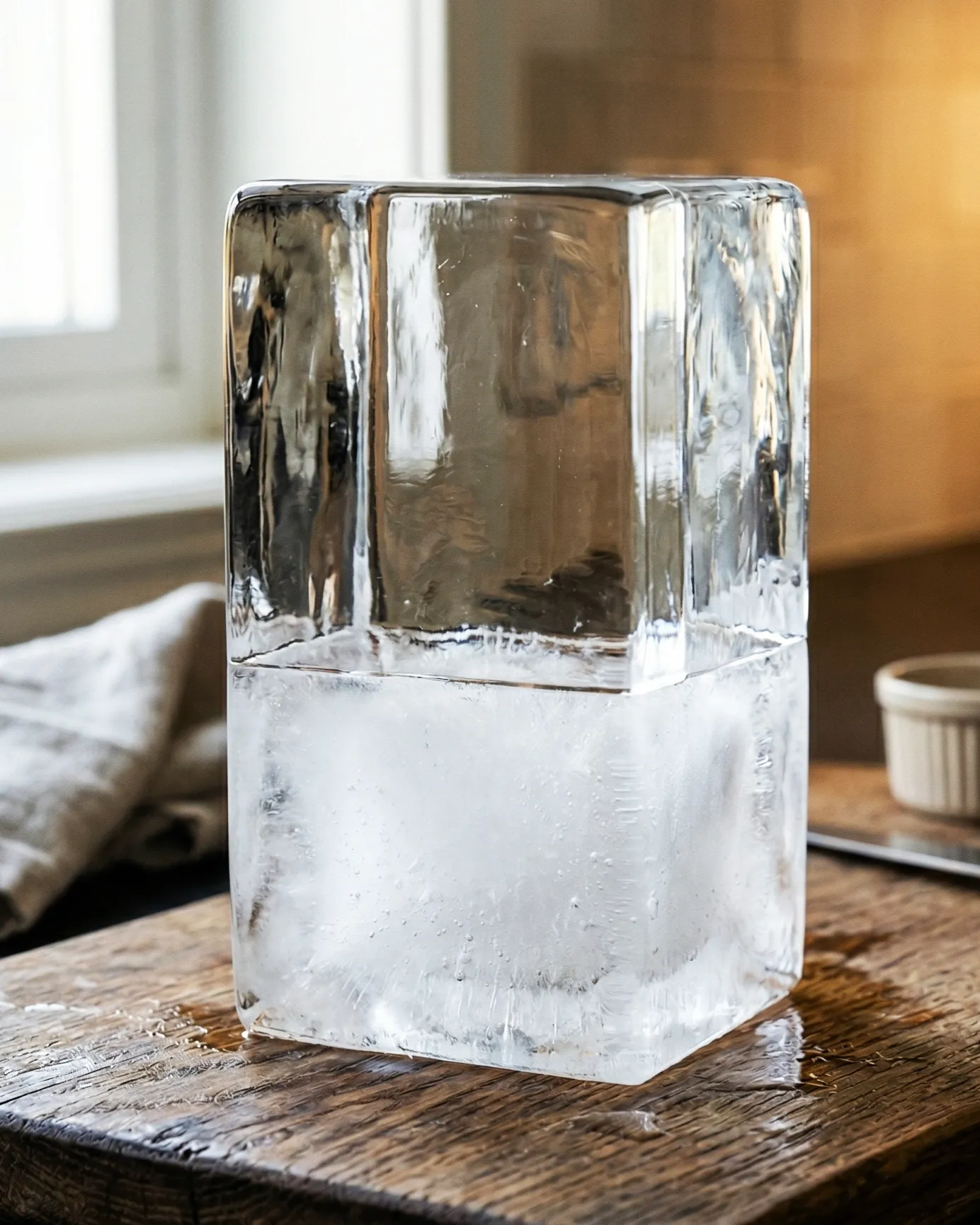
Stop before the block freezes completely / Release, invert, cut, discard the cloudy base
In practical terms:
- Fill a small cooler with filtered water
- Place it in the freezer with the lid off
- Freeze for 24 to 48 hours
- Remove before the block freezes solid
- Discard the cloudy base and cut the clear ice
The only judgment call is timing. Different freezers run at different temperatures, and the cooler size affects how fast it freezes. The first cycle is an experiment: check after 24 hours, then every six hours, until you find the sweet spot where the clear portion is as thick as possible but the bottom is still liquid or slushy. Write that number down for your next run.
If you let it freeze completely, the cloudy zone will take over the bottom third of the block and you will lose some clear ice to the discard pile. Not catastrophic, but wasteful. Stopping slightly early is better than slightly late.
Most common mistake: letting the block freeze solid and losing a large portion of the clear ice to the cloudy base.
Cutting the Block

Pull the cooler out and let it sit on the counter for ten or fifteen minutes. The block will release on its own as the outer shell melts just enough to free it. Invert the cooler over a cutting board covered with a clean kitchen towel - the towel keeps the ice from sliding and catches meltwater.
Use the knife to score a line across the top of the clear portion where you want the cut to be. Place the knife blade in the score, hold it steady, and strike the back of the knife with the mallet. The ice cracks along the score in one clean break. Repeat to cut the clear portion into planks, then the planks into cubes.
Aim for cubes roughly two inches square for rocks glasses, or long spears for collins glasses. Discard the cloudy bottom of the block. Store the finished cubes in a freezer bag.
The Dilution Math
This is the part people overlook. Clear ice is beautiful, but the real performance advantage is size, not clarity.
A standard ice cube from a freezer tray is roughly one inch square. A large cube from a clear ice block is two inches square. Double the dimensions, but eight times the volume - and only four times the surface area. That ratio is what matters.
A 2-inch cube has about one quarter of the surface area per ounce compared to a standard cube. Melting happens at the surface, so less surface per unit volume means slower melting.
In practice, a large cube cools your drink to the target temperature almost as quickly as a handful of small cubes, then holds that temperature for four times longer before meaningfully diluting the cocktail. You get cold without water.
Standard cubes hit the target fast and then keep going, over-diluting the drink within minutes. A large cube hits the target and then holds. For a spirit-forward drink you intend to sip slowly, that difference is the whole game.
A Shortcut: Clear Ice Molds
If you do not want to deal with cutting blocks, there are molds that use a similar directional freezing principle to produce clear spheres or cubes in a standard freezer.
Products like insulated sphere molds can produce reasonably clear ice with no cutting required. The trade-off is output and time. Most molds make one or two pieces per cycle and still take 24 to 36 hours.
They are a good option if you only need a couple of cubes for occasional drinks. If you want a steady supply, the cooler method is far more efficient.
If you find yourself making these regularly, you will outgrow the mold quickly.
When Clear Ice Is Worth It (And When It Is Vanity)
Not every drink benefits from this. Be honest about it.
Worth It
Any spirit-forward drink served over a single large cube in a rocks glass. Old Fashioneds, Negronis, Penicillins, Vieux Carrés, Sazeracs on the rocks. The ice is visible, the dilution rate matters, and the drink is meant to be sipped over 15 to 20 minutes. This is where clear ice earns its effort.
Vanity
Shaken drinks that get double-strained into a coupe. Highballs and gin and tonics, where the whole point is maximum surface area for cold and fizz. Any cocktail served up. In these cases, clear ice is decorative at best and counterproductive at worst. Standard cubes or crushed ice are the right tool.
Somewhere In Between
Whiskey neat over one cube. A good single malt poured over a clear 2-inch cube is a genuine experience, and absolutely worth the ice if you like drinking spirits that way. But this is closer to enjoyment than necessity - the whiskey is fine without it.

Clear ice is one of those techniques that sounds fussy until you do it once and realize the whole setup is: buy a cheap cooler, fill with water, put in freezer, wait. The total active time is maybe fifteen minutes across two days. The output is a bag of beautiful, functional cubes that genuinely improve the drinks you care about most.
You need a decent bar spoon and a jigger to make an Old Fashioned. You need clear ice to make it look and taste the way you always wanted it to. The bottle on your shelf matters. The tools matter. The ice was the last thing left.
If you are lucky enough to have a local supplier, buying clear ice is also a perfectly reasonable option. Not everyone needs to make it.
If you have the bottles for an Old Fashioned or a Negroni on your shelf, Alchemy will surface them automatically alongside everything else you can make. Clear ice is the one part you control.
Common Questions
Home freezers freeze water from all sides at once, which traps dissolved air and minerals in the center as the outer layers solidify. The result is a cloudy core. Clear ice requires directional freezing, freezing from the top down, so the air and impurities are pushed out instead of locked in.
Fill a small insulated cooler with water, leave the lid off, and place it in your freezer. The insulation forces the water to freeze only from the top, pushing air and impurities downward. After 24 to 48 hours, the top 70 to 80 percent of the block will be perfectly clear.
Clear ice itself does not melt slower than cloudy ice. What melts slower is a large ice cube compared to small cubes. A 2-inch cube has roughly a quarter of the surface area per ounce of ice compared with standard freezer cubes, which means it cools the drink fast and then melts about four times slower. Clear ice is usually the form a large cube takes because clarity and size tend to come together.
For any spirit-forward stirred drink served over a single large cube: Old Fashioneds, Negronis, Penicillins, Vieux Carrés. The ice is visible and the dilution rate matters. For shaken drinks that get strained, or drinks served up, it is vanity.