
At a glance: The Negroni is one of the great equal-parts cocktails: gin, Campari, and sweet vermouth, stirred and served over ice with orange. It looks simple, but the balance is more fragile than people think. Fresh vermouth, proper dilution, and a gin with enough backbone are what turn it from merely bitter into one of the most satisfying drinks in the canon.
There are some cocktails people respect more than they actually enjoy. The Negroni is not one of them. Once it lands for someone, it tends to become a drink they genuinely order, make at home, and come back to regularly.
The Negroni is one of those drinks I didn’t like the first time I tried it. I understood that it was important, and I could see why people ordered it, but the bitterness felt a little too assertive and the whole thing seemed more severe than enjoyable. Over time, though, that changed. What first felt harsh started to feel structured. What seemed overly bitter started to taste deliberate. Now it is one of those drinks I understand in a completely different way.
The Negroni is a simple classic on paper: equal parts gin, Campari, and sweet vermouth, stirred over ice and finished with orange. There is no citrus to brighten it, no syrup to soften it, and no complicated technique hiding behind the build. It succeeds or fails on balance alone. That simplicity is part of the reason it’s lasted, but it’s also part of why the drink can be a hard sell at first. Nothing in it is trying to make the first sip easy.
The Negroni is not a drink that tries to win everyone over immediately, and that is probably part of its appeal.
What Makes the Negroni Work
The easiest mistake with a Negroni is to assume that because the recipe is simple, the drink is foolproof. It is not. In fact, it is one of those drinks that exposes bad ingredients and bad technique very quickly, in a similar way to a Martini.
A sour has citrus to pull things into line. A more spirit-forward drink can sometimes carry an average vermouth without completely falling apart. The Negroni gives each ingredient a full third of the glass, so if one of them is tired, too soft, or simply not a good fit, you notice straight away.
That is also why it is so satisfying when it is right.
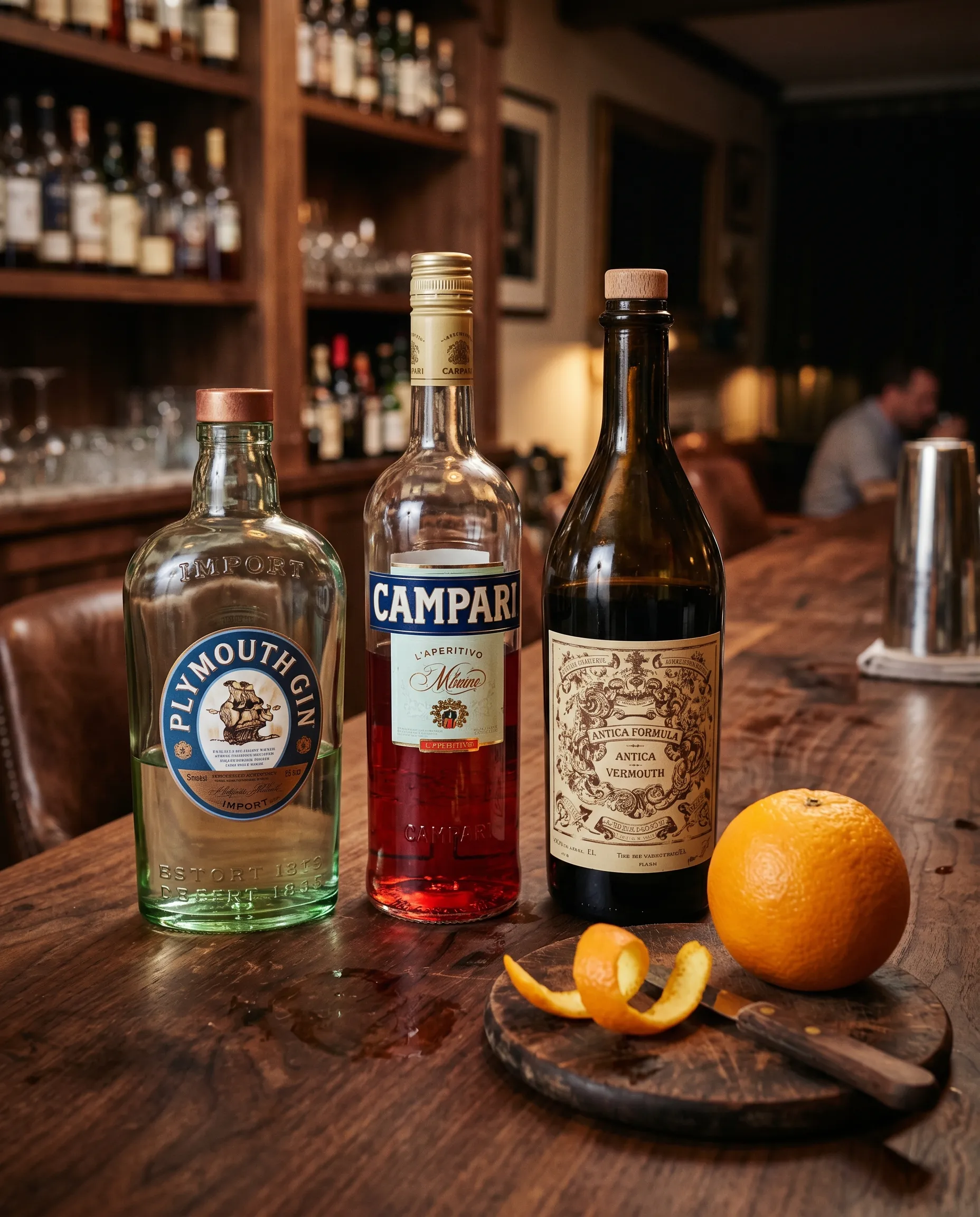
Gin
The structure. Gin gives the drink its dryness and botanical lift, and keeps the sweeter, more bitter elements from feeling too heavy. Without enough presence from the gin, the Negroni can feel weighed down.
Campari
The defining note. Campari brings bitterness, bitter orange, and the herbal edge that makes the drink unmistakable. It's not there to be disguised. It is there to give the drink its point of view.
Sweet Vermouth
The middle. Sweet vermouth connects the gin to the Campari and gives the drink depth, spice, and softness. This is also why fresh vermouth matters so much in a Negroni. If the vermouth is flat, the whole drink loses shape.
The Negroni works because those three elements keep pulling in different directions at once. The gin dries things out, the Campari sharpens the edges, and the vermouth brings it back together. None of them disappear into the background for long, which is what gives the drink its tension.
The History, Briefly
The most prominent origin story places the Negroni in Florence in 1919, when Count Camillo Negroni asked bartender Fosco Scarselli to strengthen his Americano by replacing the soda water with gin. As with a lot of cocktail history, some details are repeated more confidently than they are documented, but the broader shape of the story makes sense.
More importantly, the drink clearly belongs to the Italian aperitivo tradition. It is built around bitterness, aroma, and appetite rather than refreshment or sweetness. It is a drink meant to wake the palate up, not overwhelm it.
That is part of why the recipe is so clean. The Negroni is not trying to impress you with complexity. It is trying to make a very clear case for balance.
The Equal-Parts Question
People often ask whether the Negroni really should be equal parts.
Yes. That is the classic spec, and it is famous for a reason.
What throws some people is that equal parts sounds casual, as though the drink was assembled for convenience rather than precision. In reality, the ratio works because each ingredient is strong enough to carry equal weight. Gin is not simply the base with two modifiers hanging off it. Campari is not just there to add bitterness. Vermouth is not filler. All three are doing real work.
That said, equal parts should be the version you understand first, not necessarily the version you keep forever. Some people prefer to lean the gin slightly higher for a drier drink. Others ease the Campari back a fraction if they want the bitterness a little softer. That is fine. But the original ratio is worth learning before you start adjusting it.
The Recipe
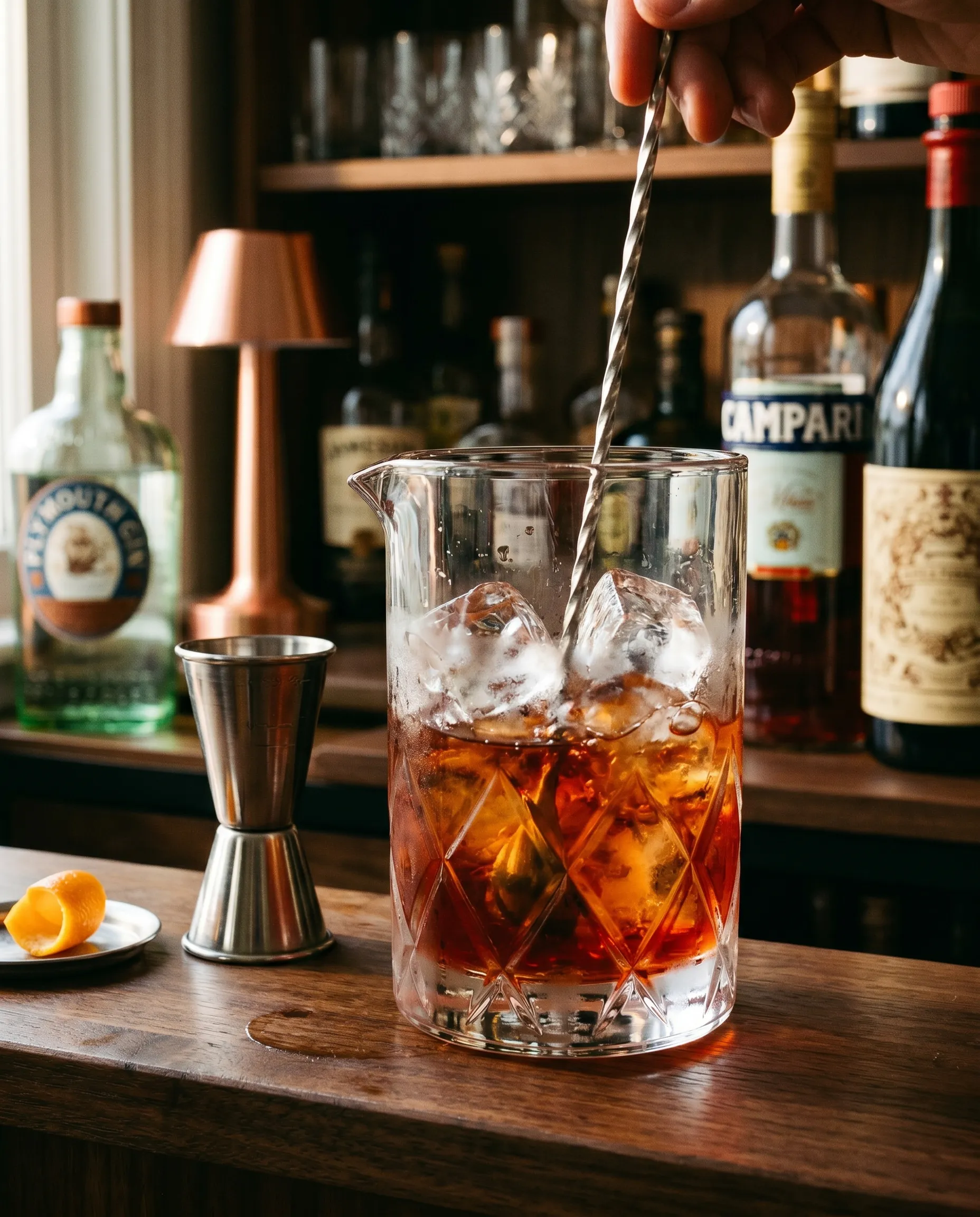
The orange peel matters more than people think. It is not just decoration. When you express it over the drink, the oils soften the first impression and link the orange side of Campari back to the botanicals in the gin. Without it, the drink can feel slightly harder and less complete.
And yes, it should be served over fresh ice. A large cube is ideal. The Negroni is usually something you sip slowly, which makes it exactly the sort of drink where clear ice genuinely improves the experience.
Choosing Your Bottles
Because there are only three ingredients, bottle choice shows up immediately in the glass.
A London Dry style is the safest starting point. You want enough juniper and structure to stand up to Campari and sweet vermouth. Very soft or overly floral gins can work, but they are more likely to disappear. This is usually not the best place for your most delicate bottle.
This is one of those cocktails where the original bottle really matters. There are other bitter aperitifs, and some of them make very good drinks, but a classic Negroni uses Campari.
This is the easiest way to tune the drink. Cocchi is balanced and versatile. Carpano Antica gives you a richer, more vanilla-forward Negroni. Dolin Rouge makes a lighter one. Whatever you use, keep it refrigerated. Vermouth is wine, and the Negroni will expose stale vermouth quickly.
Why Bad Negronis Happen
When someone says they do not like Negronis, the issue is often not the drink itself. It is the version they were served.
The usual problems are fairly predictable.
If the vermouth has been open on a shelf for months, the center of the drink disappears. What should taste balanced ends up feeling more aggressively bitter because the ingredient that is supposed to hold things together has faded.
A Negroni needs proper stirring. If it is under-diluted, it can taste hot, sharp, and more bitter than it should. Stirring is not a formality here. It is how the drink settles into itself. This is exactly the sort of drink where a decent bar spoon and a proper stirring setup help.
If the gin is too quiet, the drink can lean too far toward Campari and vermouth. What people describe as too bitter is sometimes really just a Negroni with not enough gin presence.
The Negroni and Amaro Thinking
The Negroni is one of the best introductions to bitter drinks because it shows what bitterness is doing in a cocktail, rather than just asking whether you enjoy bitter flavors in the abstract.
Campari is not there to make the drink difficult. It is there to give it shape and contrast. In that sense, the Negroni is one of the clearest examples of what amaro and bitter aperitifs do well. They stop a drink from feeling soft or forgettable.
Once that clicks, a lot of other bottles on the back bar start to make more sense.
Variations Worth Knowing
A good classic usually has a few descendants that are genuinely worth your time.
Boulevardier: bourbon or rye in place of gin. Richer, warmer, and better suited to colder weather.
Kingston Negroni: rum instead of gin. Darker, heavier, and often excellent.
Coffee Negroni: one of my personal favorites. The coffee liqueur adds a gentle sweetness that the original doesn’t have, while still keeping the bitter structure that makes a Negroni a Negroni. The result feels a little darker, a little softer, and very easy to come back to.
They are all worth trying. But the original is still the one to understand first. And if you enjoy the way a Negroni works, the Vieux Carré is its natural next step: another equal-parts stirred classic that trades bitterness for richness and shares the same sweet vermouth at its core.
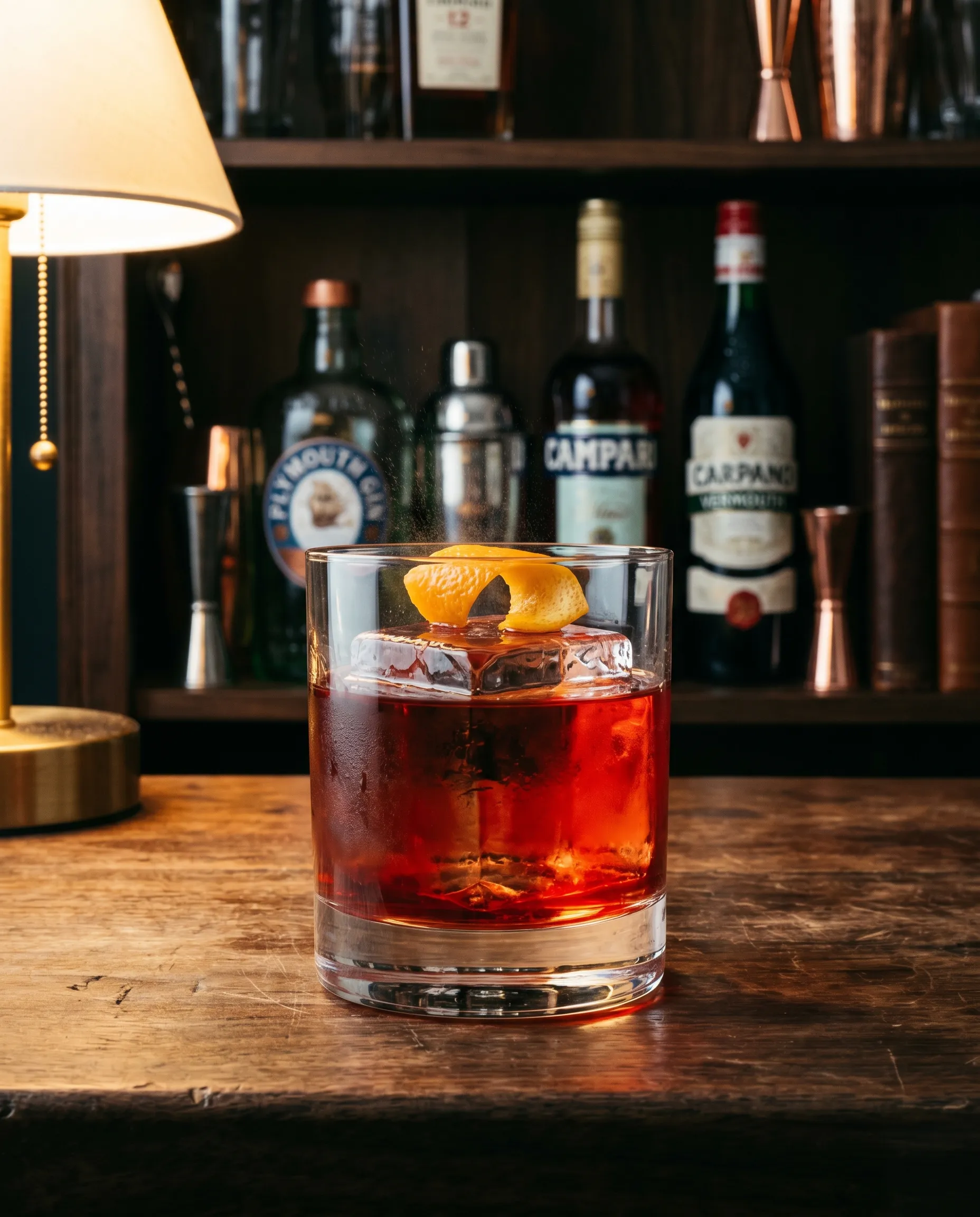
The Negroni is one of the clearest examples of why a great cocktail does not need many ingredients. Three bottles, one garnish, and a straightforward method is enough.
But that simplicity is not the same thing as forgiveness. The bottles matter. The vermouth needs to be fresh. The dilution has to be right. The orange peel needs to be there. It is easy to make a Negroni, but it is also easy to make one that misses the point.
Get it right, though, and the drink makes a very strong case for itself. It is not just a famous classic. It is one of the best arguments there is for bitterness, balance, and restraint.
If you already have gin, Campari, and sweet vermouth on your shelf, Alchemy will surface the Negroni automatically alongside everything else you can make.
Common Questions
A classic Negroni is made with equal parts gin, Campari, and sweet vermouth, stirred with ice and served over fresh ice with an orange peel.
Yes. The classic Negroni spec is equal parts gin, Campari, and sweet vermouth. Some bartenders adjust the ratio slightly, but the standard version is one of the most famous equal-parts cocktails in the canon.
A London Dry gin is the safest starting point because it has enough backbone to stand up to Campari and sweet vermouth. Beefeater, Tanqueray, and Plymouth all work well.
Usually because the vermouth is old, the drink is under-diluted, or the gin is too soft. Fresh sweet vermouth, proper stirring, and a more assertive gin usually fix the balance.